

On April 2, 2026, at the invitation of Prof. Wei Shen from the School of Life Science and Technology (SLST), ShanghaiTech University, Associate Professor Dengke Ma from the University of California, San Francisco (UCSF) visited SLST and delivered an outstanding academic lecture entitled “Engineering biological time: from C. elegans to mammals.” Prof. Ma has long been dedicated to understanding how organisms cope with environmental stress. Using models ranging from Caenorhabditis elegans to cells derived from Arctic ground squirrels capable of enduring extreme cold and hibernation, his team investigates how genes and molecules enable cells and organisms to resist stress, maintain stability, and adapt to changes in temperature and oxygen availability.
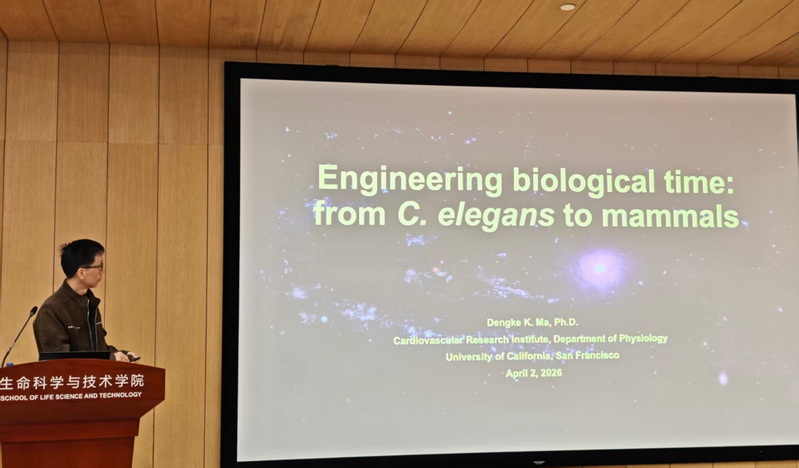
In his talk, Prof. Ma systematically introduced an important discovery from his laboratory in recent years—a reversible “diapause-like” state—and elaborated on how it regulates energy metabolism and biological time. This mechanism exists across systems from simple invertebrates to complex mammals and holds broad potential for future applications. Using C. elegans as a model, his team found that under specific liquid conditions, high-density worm populations can enter a near “time-paused” state termed liquid-induced suspended animation (LISA). In LISA, worms’ locomotion, development, and metabolic activities are almost completely halted; intracellular gene expression and metabolism undergo fundamental reprogramming, and structures such as the cell’s energy factories—mitochondria—also exhibit marked changes. The study revealed that lysosome-related pathways are essential for survival in this state, while “awakening” from dormancy is controlled by a neural pathway involving neuropeptides and cAMP/PKA signaling.
Further mechanistic work showed that inhibition of the intracellular proton pump (V-ATPase) serves as a key switch that triggers diapause. The team even identified a small-molecule compound that can rapidly and reversibly induce a diapause-like state in worms by inhibiting this “pump.”
For the “awakening” process, the team also mapped its regulatory circuitry. They found that certain specific neurons and the cAMP/PKA signaling pathway function like “arousal regulators”: loss of function in these components significantly delays awakening, whereas loss of function in other neurons can accelerate awakening.
The value of this study also lies in its generality. Prof. Ma showed that in cells from naturally hibernating Arctic ground squirrels, there exists a similar low-metabolism protective mechanism. In both worm models and Alzheimer’s disease models, mild hypoxia can also produce neuroprotective effects and extend lifespan. Even more strikingly, a small molecule named P57 can induce a hibernation-like hypothermic state in mice in vivo. This suggests the realistic possibility of applying such a “torpor-like” protective program to mammals—and potentially to humans.
Prof. Ma concluded that the LISA model provides an excellent window for understanding how organisms regulate energy to control the “clock of life.” These findings offer new ideas for fields including aging research, preservation technologies for organ transplantation, and ischemic protection in cardiovascular and cerebrovascular diseases. His laboratory is currently using interdisciplinary approaches to systematically explore both the theoretical and practical prospects of applying “life pause” strategies to higher organisms.
【Profile of Prof. Dengke Ma】
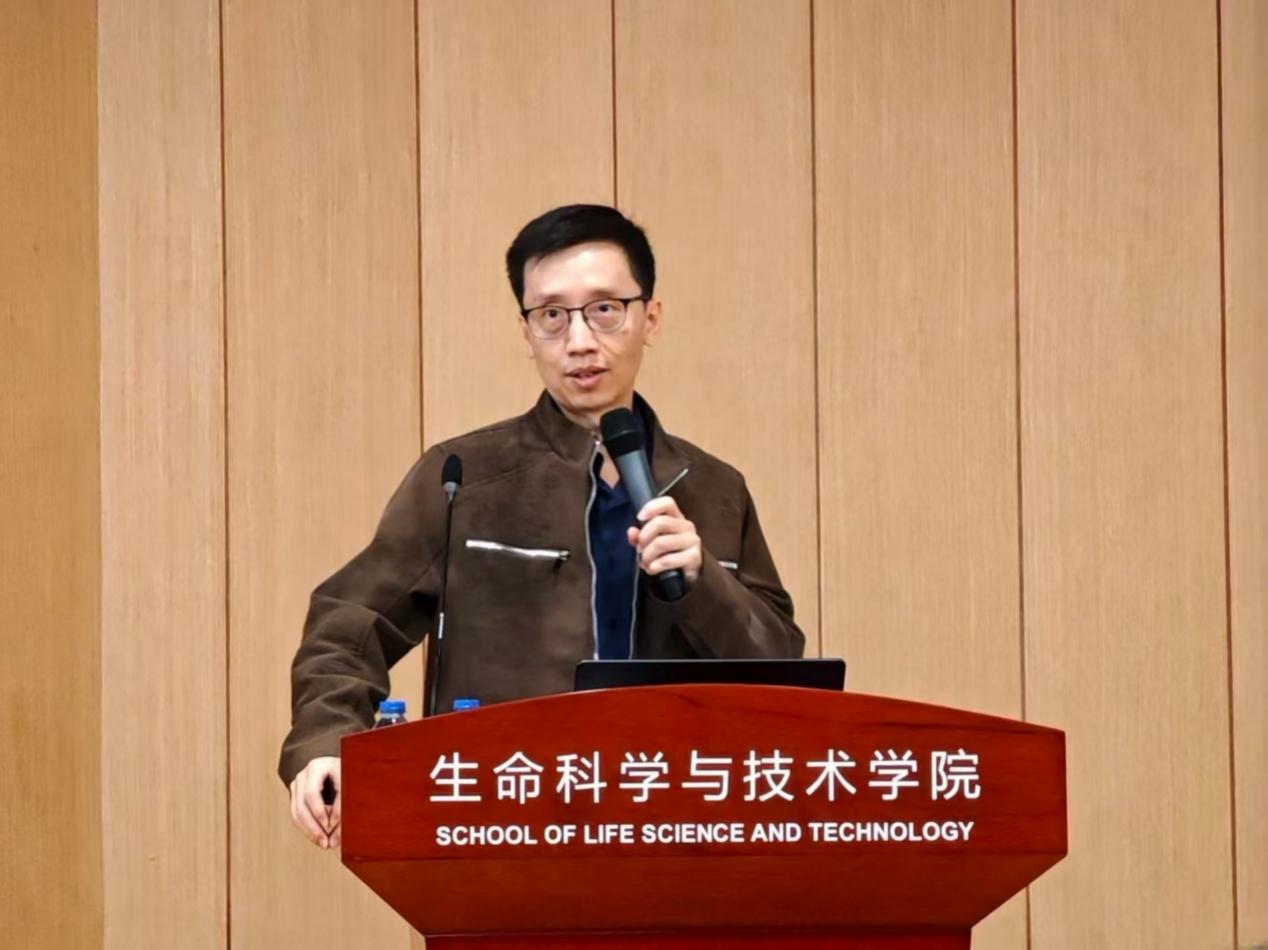
Dr. Dengke Ma is currently a tenured Associate Professor of Physiology at the University of California, San Francisco (UCSF). He earned his Ph.D. in neuroscience at Johns Hopkins University, and then conducted postdoctoral training in genetics at MIT/HHMI with Prof. H. Robert Horvitz. Dr. Ma has received numerous prestigious honors, including the NIH/NIGMS R35 MIRA Award, the Packard Fellowship in Science and Engineering, the Pew Biomedical Scholars Award, the Sloan Research Fellowship, and multiple awards from UCSF’s Program for Breakthrough Biomedical Research (PBBR). More recently, he has received the American Heart Association Transformational Project Award and the UCSF Innovation Ventures Catalyst Award.
His laboratory has made pioneering contributions in physiology and genetics, with multiple publications in top-tier journals. In addition, he has mentored many trainees, several of whom have gone on to faculty positions at universities around the world.