

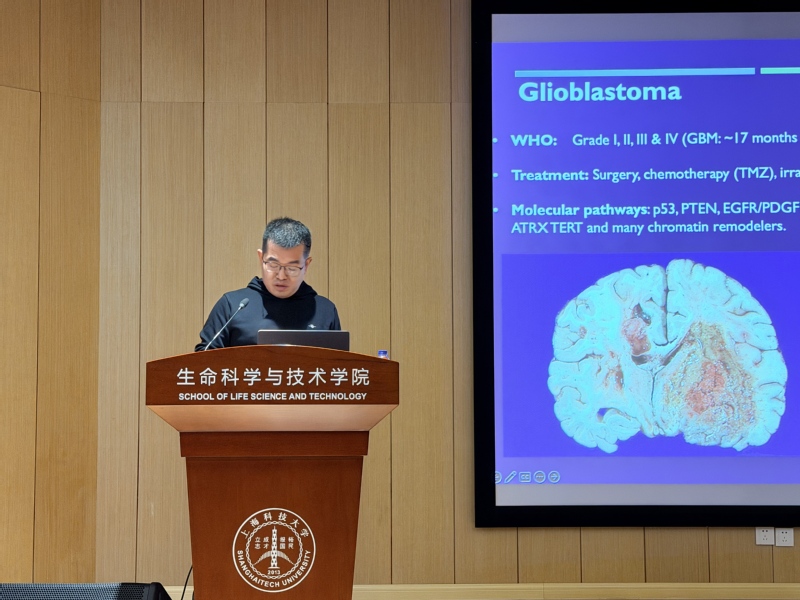
On November 11, 2025, at the invitation of Shen Wei from the School of Life Science and Technology at ShanghaiTech University, Professor Hai-Kun Liu, Director of the Department of Molecular Neurogenetics at the German Cancer Research Center (DKFZ) and Overseas Adjunct Professor at the Shanghai Institute for Advanced Immunochemical Studies (SIAIS) of ShanghaiTech, delivered an insightful lecture titled Breakthroughs in Key Challenges of Brain Tumor Research and the Layout of Clinical Researchat the Lecture Hall of Building L in the School of Life Science and Technology.
Professor Liu has long been dedicated to brain tumor research. In earlier work, he established advanced mouse models of human brain cancer, systematically investigated the molecular regulatory mechanisms of neural stem cells and brain tumor stem cells in cancer development, and was the first to reveal the stem cell origin of brain tumors and the existence of dormant cancer stem cells, providing critical targets for targeted therapies.In recent years, his team has focused on clinical translation, achieving a series of breakthroughs in the development of cancer stem cell-targeting small molecules, the construction of next-generation organoid models, and clinical trial collaborations. As the convener of the European Society for Neuro-Oncology's Preparation Group for Guidelines on Organoid-Guided Clinical Precision Medicine, he is actively promoting the layout of international clinical research in this field.
Brain tumors, especially glioblastoma (GBM), have seen a lack of therapeutic breakthroughs over the past two decades. The core challenges include strong tumor heterogeneity, insufficient predictive power of models, and significant individual differences in drug response. To address these issues, Professor Liu's team conducted systematic research:
At the molecular mechanism level, they discovered that gain-of-function mutations in IDH1convert the metabolite α-ketoglutarate to 2-hydroxyglutarate. Patients with this mutation have a significantly better prognosis, a finding that has been incorporated into tumor diagnostic guidelines, laying the foundation for precise stratification. The team also confirmed that cancer stem cells are key to tumor recurrence and drug resistance, and therapies targeting these cells can achieve long-term tumor control, more effectively suppressing tumor progression at its root compared to traditional chemotherapy.
In model innovation, the team developed patient-derived next-generation organoid models (e.g., LEGO, IPTO). Using a minimally invasive cut and paste approach, these models preserve the original spatial features and cellular composition of tumors, addressing the discrepancy between traditional models and actual patient tumors. Validated in 35 patients, the drug response results from these models highly correlate with real patient outcomes, predicting chemotherapy efficacy two to three weeks in advance and providing rapid references for clinical medication. Furthermore, by integrating data from 150 patient samples and 20 commonly used clinical drugs, the team built a deep neural network AI model that achieves single-cell-level patient-drug matching, accurately identifying responsive populations and resistance mechanisms.
In clinical translation, the team proposed a functional precision medicine approach, moving beyond genomics-guided therapy by using functional experiments in organoids to inform clinical drug use. They have initiated collaborations with a Swiss pharmaceutical company and plan to advance a window-of-opportunity clinical trial in the UK—administering drugs pre-surgery, validating responses via organoid models, and formulating personalized post-surgical treatment plans. Additionally, to address drug resistance, the team found that stress hormones like dexamethasone can induce tumor cell dormancy and resistance. They developed a combination strategy targeting the glucocorticoid receptor (GR), which significantly extended survival in mouse models, offering new directions to overcome clinical resistance.
Professor Liu's research not only clarifies the core logic of brain tumor initiation, recurrence, and resistance at the molecular level but also bridges basic research and clinical application through model innovation and AI empowerment. The organoid models and functional precision medicine strategies developed by his team provide practical solutions to the lack of precision in brain tumor therapy. The progression of related clinical trials holds the potential to reshape the landscape of brain tumor treatment and bring new hope for patient survival.
*This article was primarily generated by DeepSeek.