


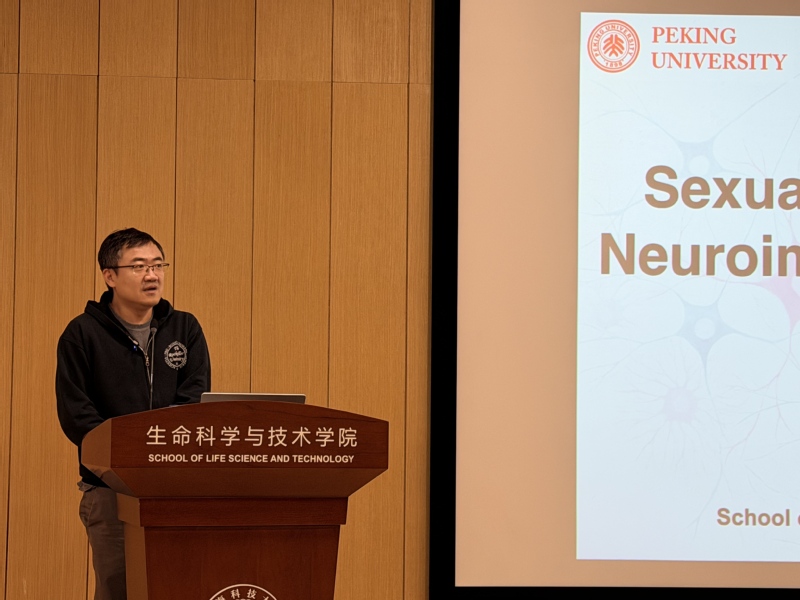
On March 11, 2026, at the invitation of Dr. Hu Ji and Dr. Shen Wei from the School of Life Science and Technology, ShanghaiTech University, Dr. Yang Jing from Peking University delivered an excellent academic report entitled “Sexual Dimorphism of Neuroimmune Regulation” in the Lecture Hall of Building L, School of Life Science.
The research team led by Dr. Yang Jing has long been engaged in the cutting-edge interdisciplinary field of biomedicine, breaking through the traditional view that the nervous system and immune system function independently, and systematically exploring the interactive regulatory mechanisms between the two systems, as well as their interactions with the metabolic and circulatory systems.His core research interests focus on four major areas: tumor neuroimmune crosstalk, metabolic diseases and complications, immune disorders and autoimmune diseases, and neurodegenerative diseases and neuroinflammation, aiming to dissect novel mechanisms of neuroimmune regulation.
Sexual dimorphism has long been observed in diverse physiological or disease conditions.It refers to the significant differences between males and females in physiological structure, function, and disease susceptibility.Such differences are particularly prominent in neuroimmunology.For example, autoimmune neurological diseases (e.g., multiple sclerosis) have a higher incidence in females, while neurodegenerative diseases (e.g., Parkinson’s disease) are more prevalent and progress faster in males. In addition, obvious sex biases also exist in infectious neuroinflammation, pain perception, and other processes.
However, the molecular and cellular mechanisms underlying these differences have long been poorly understood.In particular, whether sex differences in neuroimmune interactions within specific organs influence the above pathophysiological processes remains largely unknown.By integrating human clinical samples, animal models, advanced imaging techniques, and multi-omics approaches, Prof. Yang Jing’s team has systematically revealed previously underappreciated mechanisms of neuroimmune regulation.
During the lecture, Prof. Yang Jing shared recent breakthrough achievements from his laboratory.These findings not only clarify how neuroimmune interactions in specific organs are modulated by sex, but also provide a new perspective for understanding sexual dimorphism in a variety of important human diseases.
[Brief Biography of Professor Yang Jing]
Dr. Jing Yang is currently a Boya Distinguished Professor at the School of Life Sciences, Peking University. He also holds positions as a Principal Investigator at the Peking University McGovern Institute for Brain Research and the Peking-Tsinghua Center for Life Sciences. Additionally, he serves as an Honorary Professor at Peking Union Medical College Hospital and a Jointly Appointed Professor at Peking University Third Hospital.
Dr. Yang received his Bachelor of Science degree in Biological Sciences from the School of Life Sciences at Peking University in 2003. He earned his Ph.D. in Biomedical Sciences in 2009 from the University of Texas Southwestern Medical Center, where he trained under the mentorship of Nobel laureates Dr. Michael Brown and Dr. Joseph Goldstein. From 2009 to 2015, he conducted his postdoctoral research under the guidance of Professor Marc Tessier-Lavigne, first at Genentech and subsequently at The Rockefeller University. In 2015, he joined the faculty of the School of Life Sciences at Peking University.