


On March 6, 2026, Dr. Ying Li from Chinese Institute for Brain Research gave an academic lecture titled "Neural Basis of Adaptive Social Behavior" at the School of Life Science and Technology, ShanghaiTech University. This report focuses on how the brain encodes internal states to regulate social behavior and presents these findings through three levels of research.
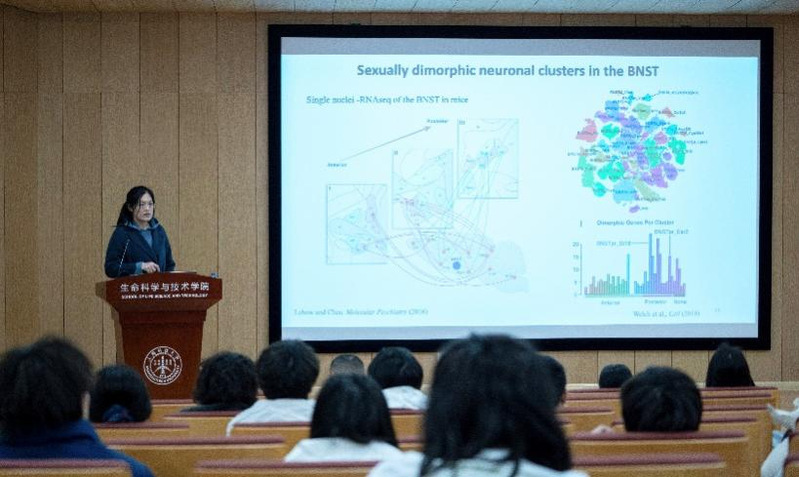
First is innate social behaviors. Fixing on social behaviors such as mating, the team used mini scope imaging to identify specific Esr2 neurons in the bed nucleus of the stria terminalis (BNST) which were activated after mating in mice. The excitation of these neurons was proved both sufficient and necessary for reducing mating motivation, revealing a neural "switch" for instinctive behavior.
Secondly, focusing on learned social behaviors during the Juvenile Period, the team developed a proprietary 3D motion-capture system. They found increased dopamine signals in the nucleus accumbens (NAc) in rats during social interaction, which was impaired in Shank3 autism model rats. Using a real-time closed-loop optogenetics system to provide "artificial reward", they successfully reshaped the social strategies of the model rats, thereby restoring normal social interaction in adulthood.
Finally, to explore complex social adaptation, the research extended to non-human primates (marmosets). The study found dynamic interactions between neural representations of fear-related activity and social contact, providing a cortical basis for understanding how emotional states regulate social expression in real time.
During the Q&A session, Dr. Ying Li suggested that individual differences in social behavior may stem from varying sensitivities of dopamine circuits to feedback during early development. She also noted that "reopening" social plasticity in adulthood through specific means offers a promising new approach for treating social disorders in adults. The lecture not only advanced scientific understanding of the neural mechanisms underlying adaptive social behavior but also highlighted promising directions for future diagnosis and treatment of social disorders.
[Brief Biography of Dr. Ying Li]
Dr. Ying Li received her bachelor’s degree in 2007 from Nanjing University and her Ph.D. in Neuroscience in 2013 from Institute of Neuroscience, Chinese Academy of Science. She completed a postdoctoral fellowship at Molecular and Cellular Biology, Harvard University. She joined Chinese Institute of Brain Research, Beijing in 2019. Professor Ying Li aims to uses both rodent and non-human primate models to understand the neural mechanisms involved in the generation of adaptive social behaviors.