


Recently, the research group of Bo Sun from the School of Life Science and Technology at ShanghaiTech University, in collaboration with other researchers, has made significant progress in the study of the transcriptional regulatory mechanisms of the Hippo signaling pathway. The related findings, titled "VGLL4-driven TEAD4 multimerization orchestrates DNA binding and YAP recruitment", have been published in the international academic journal Nature Communications. By monitoring the dynamic process by which the Hippo pathway transcription factor TEAD4 binds its DNA targets, the study reveals a novel molecular mechanism: the cofactor VGLL4 modulates the multimerization state of TEAD4, thereby regulating the recruitment of the transcriptional coactivator YAP in a stoichiometry-dependent manner.
The Hippo signaling pathway is a highly conserved kinase cascade, that plays a central role in regulating cell proliferation and growth, tissue homeostasis, and organ development. In mammals, the transcription factors TEAD1-4 are key downstream effectors of this pathway. They specifically recognize the MCAT DNA and collaborate with cofactors such as VGLL1-4 and YAP/TAZ to regulate gene expression, thereby governing various processes related to cell proliferation and differentiation. However, the dynamic process of TEAD binding to DNA and the precise regulatory mechanisms of its cofactors remained unclear.
This study combined fluorescence confocal microscopy with optical tweezers to achieve real-time, dynamic observation of TEAD4-DNA interactions. The results showed that monomeric TEAD4 can bind MCAT sequences with a relatively fast association rate, but it also dissociates rapidly, resulting in a short residence time on DNA (Figure 1, top). However, TEAD4 can form multimers, and significantly prolong its residence time on DNA. Both cofactors YAP and VGLL4 can promote TEAD4 multimerization and enhance its sequence specificity (Figure 1, middle). Further research revealed that VGLL4 uniquely exhibits a biphasic, stoichiometry-dependent regulation on TEAD4's recruitment of YAP. Specifically, VGLL4 promotes TEAD4 multimerization at low VGLL4:TEAD4 molar ratios to enhance YAP recruitment, whereas at high ratios, VGLL4 inhibits YAP recruitment by saturating the TEAD4 YBD domain. This discovery uncovers a precise regulatory switch within the Hippo pathway based on the relative abundance of cofactors.
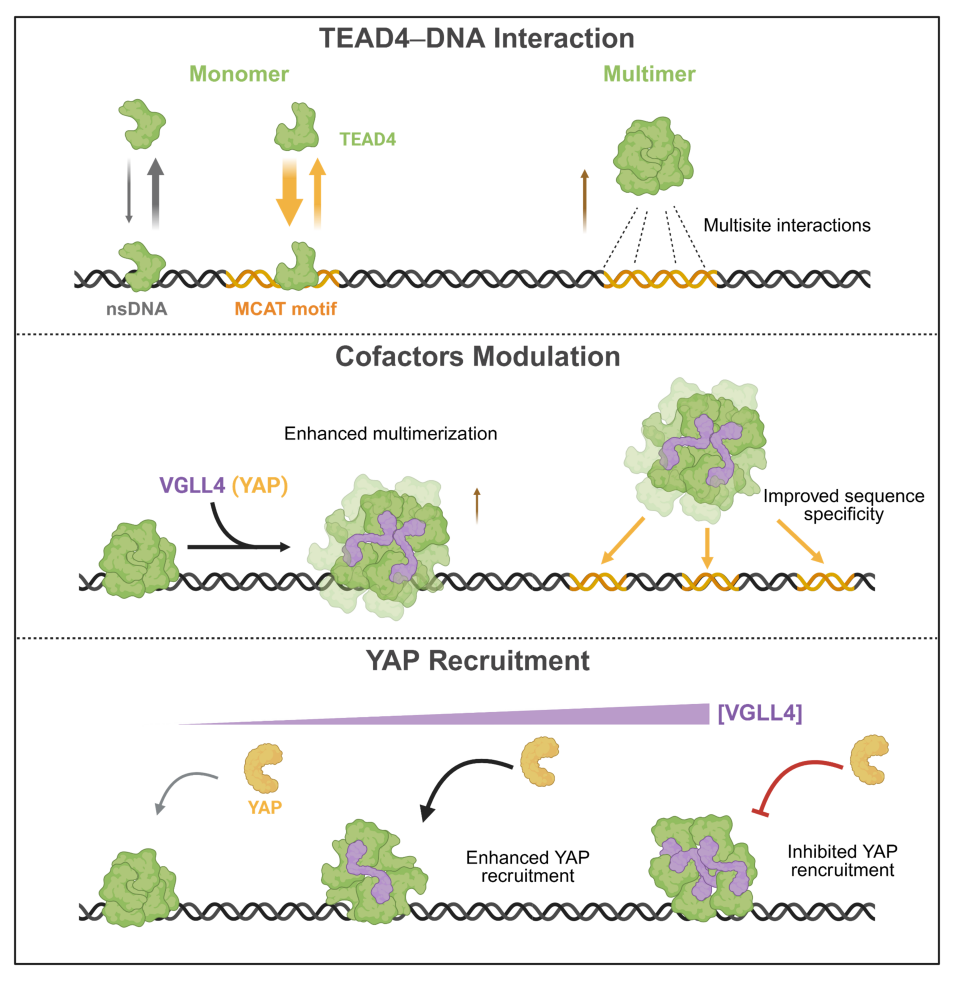
This work is the first to dynamically dissect the complete process of interaction between the eukaryotic transcription factor TEAD4 and DNA at the single-molecule level. It not only advances the understanding of the fundamental principles of transcription factor function but also elucidates a novel molecular mechanism by which VGLL4 precisely balances YAP recruitment by regulating the multimerization state of TEAD4. These findings provide an important theoretical basis for a deeper understanding of the dynamic regulation of the Hippo signaling pathway and its role in development and disease.
Zhiyun Ren, a 2022 Ph.D. student, and Yilin Zhao, a 2024 Ph.D. graduate from the School of Life Science and Technology at ShanghaiTech University, are the co-first authors of the paper. Associate Professor Bo Sun, Professor Lei Zhang from Shanghai Jiao Tong University, and Associate Researcher Yunyun Jin are the corresponding authors. ShanghaiTech University is the primary affiliation of the authors.
Paper link: https://doi.org/10.1038/s41467-026-71766-5