

On April 13, 2026, Professor Noboru Mizushima from The University of Tokyo delivered an academic lecture titled "Intracellular Degradation by Autophagy and its Related Pathways" at the School of Life Science and Technology, ShanghaiTech University. The lecture was held upon the joint invitation of Professor Katsuhiko Mikoshiba and Professor Liu Yanfen.
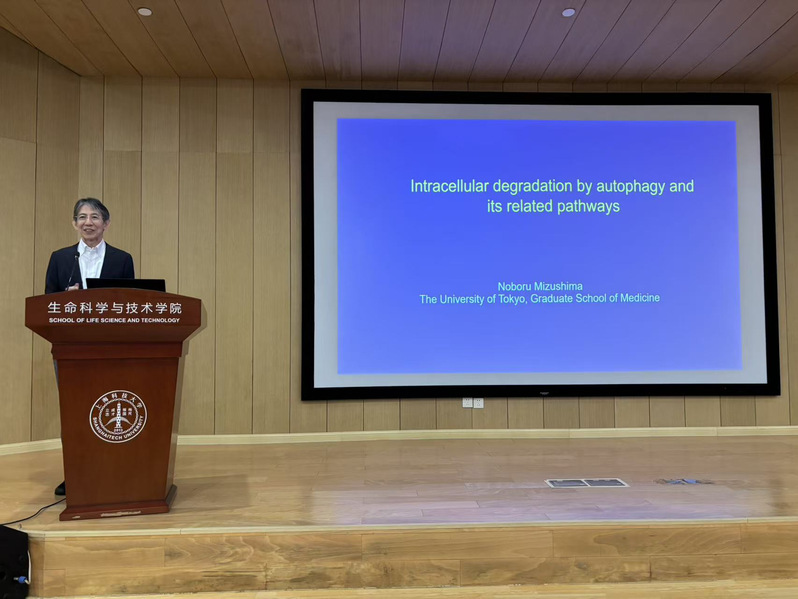
Autophagy is a highly conserved intracellular degradation system in eukaryotes. Cytoplasmic components are enveloped by a double membrane to form autophagosomes, which are then transported to lysosomes for degradation and recycling. Since Professor Yoshinori Ohsumi's groundbreaking discoveries in yeast, the field has progressed rapidly in understanding its molecular mechanisms and physiological functions. Professor Mizushima's work has systematically elucidated the autophagy process in mammalian systems, establishing a research framework for studying it under physiological conditions.
During the lecture, Professor Mizushima first elaborated on the two core functions of autophagy: firstly, breaking down intracellular components to provide nutrients and energy; and secondly, serving as a quality control mechanism to clear abnormal proteins and organelles. He then highlighted three recent breakthroughs achieved by his team:
1. Unraveling the Efficient Fusion Mechanism of Autophagosomes and Lysosomes: The study found that the Qa-SNARE protein Syntaxin 17 (STX17) is key to mediating their fusion. As autophagosomes mature, the enrichment of phosphatidylinositol 4-phosphate (PI4P) on their membranes increases the negative surface charge. The tail of the STX17 protein is rich in positive charges, allowing it to specifically localize to the mature autophagosome membrane through charge complementarity, subsequently assembling the SNARE complex to drive membrane fusion. This research reveals a precise sorting mechanism based on dynamic changes in membrane lipids and charge recognition.
2. Establishing a Reversible Autophagy-Deficient Mouse Model: Utilizing Doxycycline regulation, the team established a mouse model with reversible knockdown of the key autophagy gene ATG101. This model demonstrated that neuronal dysfunctions (such as abnormal protein aggregation and axonal swelling) caused by autophagy deficiency could be significantly improved upon the restoration of autophagic function. This provides an important theoretical basis for intervention strategies in neurodegenerative diseases.
3. Discovering a Novel Organelle Degradation Pathway Independent of Canonical Autophagy: During the terminal differentiation of eye lens cells, organelles are cleared on a large scale, a process independent of canonical autophagy. Research indicates that the highly expressed PLAAT family genes (encoding phospholipase A and acyltransferases) in the lens are crucial. PLAAT proteins can translocate to the membranes of damaged organelles, promoting their disintegration and releasing the contents into the cytoplasm for degradation. This novel mechanism is essential for maintaining lens transparency and expands our understanding of organelle degradation pathways.
Following the report, attending faculty and students engaged in a lively discussion with Professor Mizushima on topics such as the specific recognition mechanism of STX17 and the non-autophagic degradation pathway in the lens.
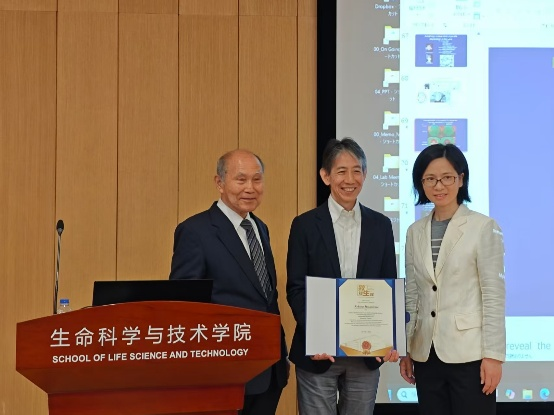
[Biography of Professor Noboru Mizushima]
Noboru Mizushima, a professor at The University of Tokyo, is a leading scholar in the field of autophagy research. Building upon and expanding the pioneering work of his mentor, Nobel Laureate Yoshinori Ohsumi, he has systematically clarified the molecular mechanisms and physiological functions of autophagy in mammalian systems, laying the foundation for understanding its role in development, metabolism, and disease.
Professor Mizushima graduated from the Faculty of Medicine, Tokyo Medical and Dental University (TMDU) in 1985 and obtained his Ph.D. in Medical Science from the same university in 1991. He conducted postdoctoral research and served as an assistant professor in Dr. Ohsumi's laboratory. He later held positions as a laboratory head at the Tokyo Metropolitan Institute of Medical Science and a professor at TMDU. Since 2012, he has been a professor in the Department of Biochemistry and Molecular Biology at The University of Tokyo, and since 2021, he has served as the Deputy Director of the Graduate School of Medicine. He has received numerous prestigious awards, including the Takeda Medical Prize (2011), the Uehara Prize (2016), the Fujihara Prize (2020), the Medal with Purple Ribbon (2021), and the Beth Levine Award in Autophagy Research (2023). He has also been consecutively listed as a Highly Cited Researcher by Clarivate. He has served as the former president of both the Japanese Biochemical Society and the Molecular Biology Society of Japan. He is currently the President of the Japan Society for Cell Biology and serves as a reviewing editor or editorial board member for several international journals.