

On March 30, 2026, Professor Ivan Dikic from Goethe University Frankfurt delivered a fascinating academic lecture titled Guardian of Cellular Homeostasis – The Ubiquitin and Autophagy Network at the L Building Lecture Hall of the School of Life Science and Technology, ShanghaiTech University. The lecture was held upon the invitation of Professor Zhuang Min.
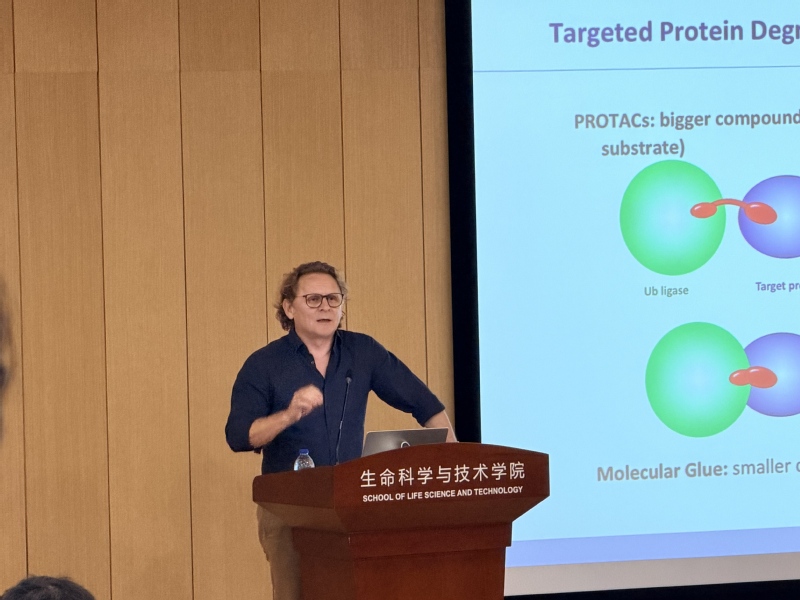
Cellular homeostasis relies on a highly coordinated quality control system. This system monitors organelle function, genomic stability, and protein integrity, and eliminates harmful intracellular substances in a timely manner through ubiquitin-dependent protein degradation and selective autophagy, thereby protecting cells from damage caused by proteotoxicity, metabolic stress, and genotoxic stress. Professor Dikic's recent work focuses on the role of ubiquitination in endoplasmic reticulum-selective autophagy and remodeling mechanisms, as well as novel proximity-inducing therapies including PROTACs and molecular glues.
During the lecture, Professor Dikic first explained how the ubiquitination pathway participates in and coordinates multiple important biological processes such as protein degradation, autophagy, and DNA damage repair. He then shared two of his team's latest research findings:
DNA–protein crosslinks (DPCs) are a severe type of DNA damage caused by covalent linkage between proteins and DNA. His laboratory discovered that the metalloprotease SPRTN is essential for DPC repair, and further investigated how ubiquitination-related processes effectively eliminate DNA–protein crosslinks to ensure normal DNA replication. This study provides new insights and potential targets for cancer therapy.
Contact-phagy is a novel form of selective autophagy proposed by Professor Dikic. Unlike traditional selective autophagy targeting a single organelle, contact-phagy acts at organelle contact sites and can simultaneously perform selective autophagy on two organelles. This mechanism expands the scientific community's understanding of selective autophagy.
Finally, Professor Dikic briefly introduced the PROXIDRUGS project, which focuses on developing proximity-inducing therapies including PROTACs and molecular glues. These therapies utilize ubiquitin-dependent degradation mechanisms to target disease-associated proteins, nucleic acids, and even organelles, offering new strategies for disease treatment.
After the presentation, faculty and students engaged in a lively discussion with Professor Dikic regarding the related molecular mechanisms.
[About Professor Ivan Dikic]
Professor Ivan Dikic is a world-leading expert in the fields of ubiquitin biology and autophagy. He is internationally recognized for revealing how abnormalities in these pathways lead to human diseases, including cancer, infectious diseases, and neurodegenerative disorders. His recent research focuses on endoplasmic reticulum remodeling mechanisms and the development of novel proximity-inducing therapies, including PROTACs and molecular glues. Professor Ivan Dikic is a member and Vice President of the EMBO Council, and an elected fellow of the German National Academy of Sciences Leopoldina, the Academia Europaea, and the American Academy of Arts and Sciences.
* This article was primarily generated by DeepSeek.