


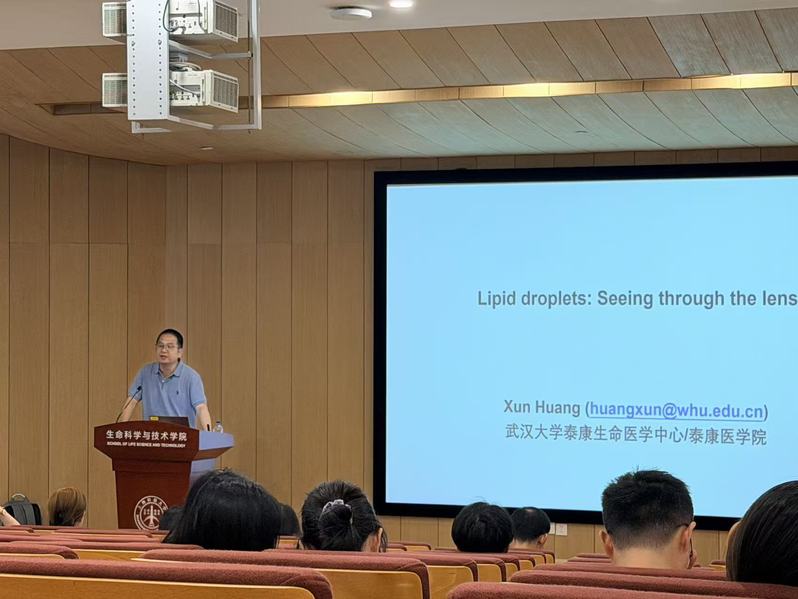
June 5, 2026 — Professor Xun Huang from Taikang Medical School (School of Basic Medical Sciences), Wuhan University, was invited by Professor Wei Qi from the School of Life Science and Technology, ShanghaiTech University, to deliver a fascinating academic lecture titled Lipid droplets: Seeing through the lens at the L Building Lecture Hall.
Lipid droplets (LDs) are essential lipid storage organelles in eukaryotic cells. Metabolic diseases such as obesity, diabetes, and fatty liver, which result from abnormal lipid metabolism, are closely associated with aging, cardiovascular diseases, cancer, and neurodegenerative diseases. Cells achieve lipid income through lipid uptake, lipogenesis, and storage, and expenditure through lipolysis, oxidation, and efflux, jointly maintaining intracellular lipid droplet homeostasis. However, cone cells typically contain only a single large lipid droplet, and the mechanisms underlying its formation and biological significance have remained unclear for a long time.
In the lecture, Professor Huang first introduced that under physiological conditions, lipid droplets mainly reside in glial cells and are rarely found in neurons. Studies have shown that neuronal lipid droplet dynamics are regulated by a tug-of-war balance between lipolysis and lipogenesis. Lipolysis within neurons (e.g., mediated by ATGL-1/LID-1) promotes the synthesis of polyunsaturated fatty acids (PUFAs), which in turn drives neurodegeneration through PUFA-containing phospholipids. Conversely, safe storage of PUFAs in neuronal lipid droplets effectively alleviates lipotoxicity, thereby slowing the progression of neurodegeneration.
Although most neurons lack lipid droplets, cone cells — a special type of neuron in the vertebrate retina — naturally possess a unique single oil droplet (LD). The formation of this single large lipid droplet depends on the microtubule system and the synergistic action of the lipid droplet fusion protein Cidea. The microtubule network facilitates the transport and clustering of multiple small lipid droplets toward specific cellular regions, while Cidea further mediates fusion between lipid droplets, ultimately forming a mature large lipid droplet. This study elucidates for the first time the molecular basis for the formation of the single lipid droplet structure in cone cells, providing a new perspective for understanding energy metabolism regulation in photoreceptor cells.
The team further discovered that cone cell lipid droplets are typically localized near the minus ends of microtubules and remain tightly associated with the microtubule-organizing center (MTOC). In screening for relevant localization factors, researchers found that the classical centriolar protein Centrin is not restricted to the centriole but can also localize to the lipid droplet surface. This finding suggests a previously unrecognized functional connection between lipid droplets and the cytoskeletal organizing center, opening new avenues for understanding the spatial organization of organelles.
Finally, using BioID proximity labeling screening, the team identified that the long isoform of SPDL1 (SPDL1-L) specifically localizes to the lipid droplet surface. Further studies showed that SPDL1-L is widely present in mammals but is absent in mice; it is highly expressed in human brain tissue and neuroblastoma cells. Functional experiments revealed that overexpression of SPDL1-L significantly promotes lipid droplet clustering, a process dependent on an intact microtubule network. Mechanistic studies further demonstrated that the hydrophobic domain and the basic amino acid-rich region of SPDL1-L together mediate its lipid droplet localization ability. This work identifies a new class of lipid droplet-associated proteins and reveals their important role in regulating lipid droplet organization and distribution via the microtubule system.
At the end of the lecture, Professor Huang discussed the potential functions of lipid droplets in nervous system development and disease, integrating the latest advances in lipid droplet biology. Faculty and students engaged in an in-depth exchange on topics such as the evolutionary origin of SPDL1-L and the physiological significance of lipid droplet clustering, resulting in a lively discussion atmosphere.
[About Professor Xun Huang]
Professor Xun Huang received his B.S. from Xiamen University in 1994, his M.S. from the Institute of Microbiology, Chinese Academy of Sciences in 1997, and his Ph.D. from the University of California, Santa Cruz in 2003. He then pursued postdoctoral research at Stanford University. From October 2006, he served as a principal investigator at the Institute of Genetics and Developmental Biology, Chinese Academy of Sciences. Since September 2025, he has been a Hongyi Distinguished Professor at Wuhan University and a PI at the Taikang Center for Life and Medical Sciences. Since the end of 2025, he has served as Dean of Taikang Medical School. His research focuses on the regulatory mechanisms of fat metabolism and the molecular mechanisms underlying developmental and metabolic diseases. He is an Executive Council Member of the Biophysical Society of China and Chair of its Metabolic Biology Division; Executive Council Member of the Chinese Zoological Society and Chair of its Developmental Biology Committee. He serves as Editor-in-Chief of Yi Chuan(Hereditas) and Associate Editor of Life Metabolism.
* This article was primarily generated by DeepSeek.