

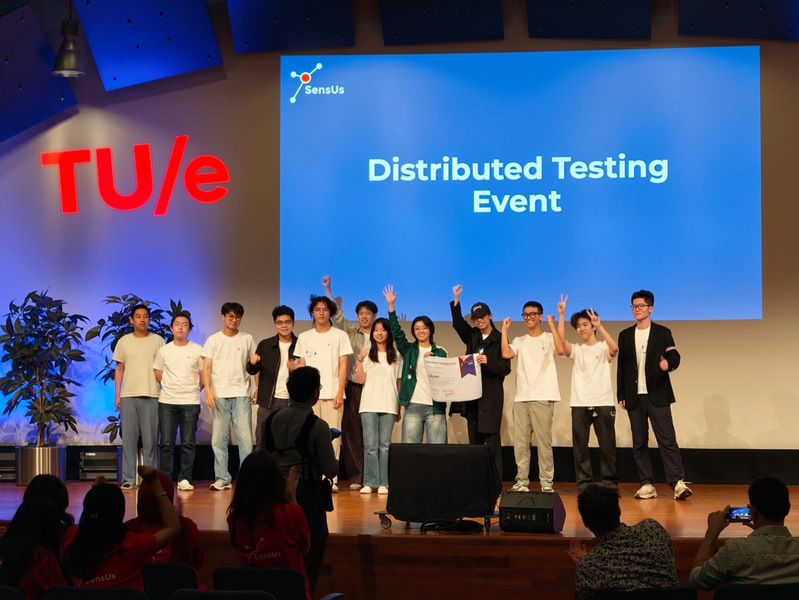
EIINDHOVEN, Netherlands — ShanghaiTech University’s MakeSense team won three awards at SensUs 2026, the international student competition on health biosensors hosted by Eindhoven University of Technology. The team placed second in the Analytical Performance Award, ranked first in the Distributed Testing Event Award, and received the SensUs Final Medal.
SensUs 2026 focused on continuous monitoring of levodopa (L-DOPA) for Parkinson’s disease. Individual patients absorb and metabolize the drug differently, and concentration fluctuations can trigger “on-off” episodes and dyskinesia. Clinicians mostly rely on centralized laboratory testing, so wearable, real-time monitoring is seen as key to personalized therapy.
MakeSense built a wearable electrochemical system for interstitial fluid. It integrates an enzyme-based recognition interface, flexible three-electrode microfilaments, and a coin-sized picoampere readout unit that continuously acquires data and transmits results wirelessly. The team also used AI-assisted protein design to create a customized receptor that selectively recognizes levodopa while resisting interference from similar compounds.
In the pre-final Distributed Testing Event, the system ranked first for detection accuracy. At the on-site final, the team further optimized the device and performed sample testing with implantable microfilament electrodes of 0.4 mm diameter, securing second place in analytical performance. The team also completed all required challenge tasks and was awarded the SensUs Final Medal.
The multidisciplinary team included students from SLST, SIST, BME, SPST, and SCA, covering protein design, electrochemistry, microfilament fabrication, low-noise electronics, animal experiments, software, and system integration.
“From lab development to the international stage, we learned that turning a scientific concept into a reliable sensing system requires close cross-disciplinary collaboration and repeated experimental validation,” said team lead Yangbin Chen. “We will keep improving the system and advancing practical translation to benefit patients.”
Support came from the School of Life Science and Technology’s translational fund and the undergraduate research/teaching platform; ShanghaiTech’s small-scale, international, and interdisciplinary institutional setup helped form the cross-school team.
SensUs is an annual competition bringing together student teams, industry, patients, and healthcare professionals to accelerate biosensor innovation. Past and current award categories include Analytical Performance, Innovation, Translation Potential, Public Inspiration, and distributed-testing recognition.