


On September 7, 2026, at the invitation of Professor Dou Kun from the School of Life Science and Technology at ShanghaiTech University, Professor Guo Zheng of Huazhong University of Science and Technology (HUST) delivered a stimulating academic lecture titled Intestinal stem cells count self-renewal divisions to switch multipotency in the Lecture Hall of Building L.
Professor Guo has long been dedicated to research on the multipotent differentiation of intestinal stem cells, seeking to understand the intrinsic physiological logic and molecular basis of stem cell differentiation, with the goal of enabling differentiation-oriented translational therapies for cancer. For a long time, the prevailing view in the field held that the differentiation of stem cells into nutrient-absorbing enterocytes (absorptive intestinal epithelial cells) and hormone-secreting enteroendocrine cells was a stochastic event, with stable proportions maintained only by statistical rules. This model, however, fails to account for the precision of these proportions and the uniformity of their spatial distribution within a limited number of divisions—a central puzzle in stem cell biology.
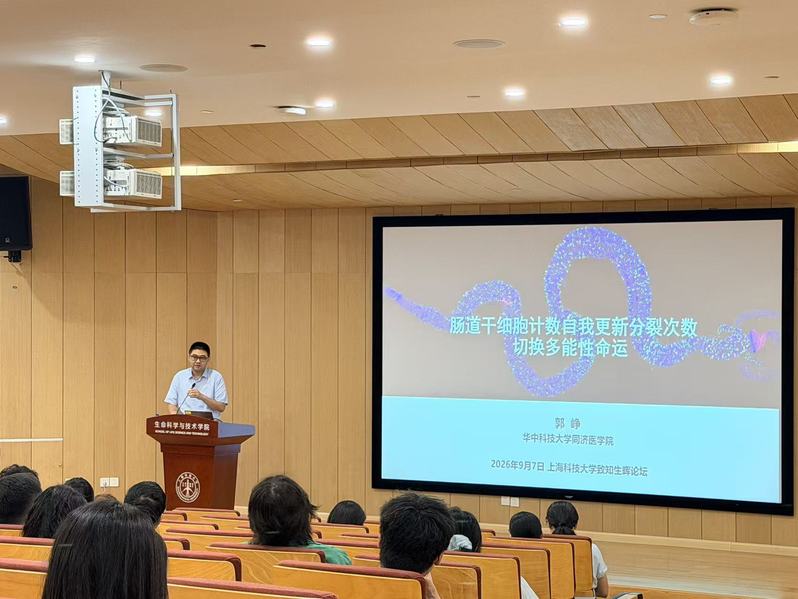
Over more than a decade of sustained investigation, Professor Guo's team used the Drosophila intestinal stem cell as a classic model and, through lineage tracing, genetic screening and mathematical modeling, completed a full-chain validation running from phenomenological observation to molecular mechanism. The study found that stem cells follow a fixed 8+1 temporal rule: after eight consecutive divisions that generate enterocytes, the ninth division precisely switches to producing an enteroendocrine cell, naturally maintaining a constant proportion of enteroendocrine cells at roughly 10%. Even under the proliferative pressure of injury-induced intestinal repair, this counting mechanism remains highly robust. The team further dissected the core molecular mechanism: the antagonistic proteins TrxG and PcG act through dynamic histone modifications to build an intracellular division counter—during divisions, activating histone marks are progressively diluted while repressive marks gradually accumulate, and once a threshold is reached, the differentiation switch is triggered. Newly generated enteroendocrine cells, in turn, transiently reset the counter via Notch signaling, initiating a new round of the cycle. In the end, the team deciphered the mechanism by which stem cells count their own division numbers through histone modifications to precisely regulate their differentiation fate.
Following the lecture, Professor Guo engaged in a lively discussion with the faculty and students in attendance.
[About Professor Guo Zheng]
Professor Guo Zheng is currently Professor and Chair of the Department of Genetics, School of Basic Medicine, Tongji Medical College, Huazhong University of Science and Technology. He received his Ph.D. from the Institute of Genetics and Developmental Biology, Chinese Academy of Sciences, in 2010, and subsequently conducted postdoctoral research at the Columbia University Medical Center in the United States. In 2016, he joined the School of Basic Medicine of HUST and was selected for a national overseas talent program. His laboratory currently uses Drosophila and mouse models to conduct in-depth studies of the multipotent differentiation of intestinal stem cells, aiming to understand the intrinsic molecular basis and physiological logic of stem cell differentiation. In the past five years, he has published—as sole or last corresponding author—in leading international journals including Nature, Developmental Cell, Nature Communications, PNAS, Science Advances, Cell Reports and Development, elucidating the mechanisms of intestinal stem cell fate determination and multipotent differentiation, and offering new research perspectives for intervening in stem cell differentiation-related proliferative diseases.
* This article was primarily generated by DeepSeek.