

On October 9, 2026, at the invitation of Associate Professor Zhang Liye of the School of Life Science and Technology (SLST), Professor Zhao Xingming delivered a lecture titled Multidimensional Data-Driven Exploration of Brain Diseases in the L Building lecture hall.
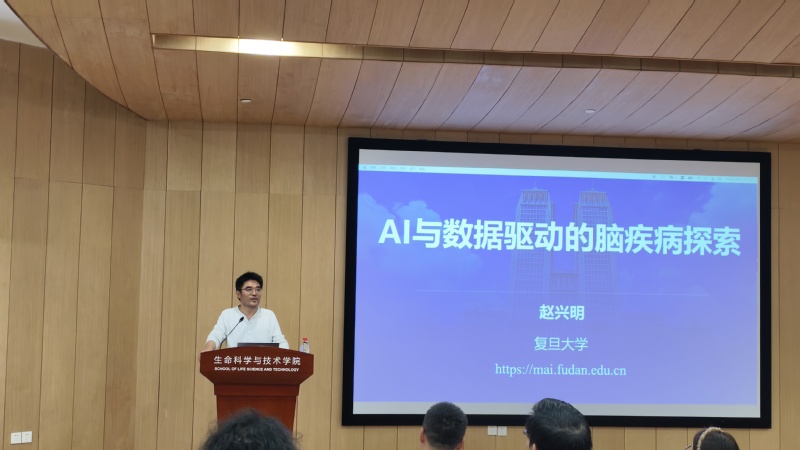
Professor Zhao has long worked at the intersection of artificial intelligence and biomedicine, focusing on big-data mining in brain science and brain-inspired intelligence. In his talk, he argued that in the big-data era, data have become the cornerstone of brain research and a key to understanding the brain, elucidating the mechanisms of brain disease, and developing brain-inspired intelligence. Drawing on his team's recent work, he reviewed advances across multiple scales of brain data, including the cellular composition of the human brain, gene-regulatory mechanisms underlying brain function, and the genetic and microenvironmental factors contributing to brain disorders, and discussed data-empowered pathways linking basic brain research to clinical translation. The talk was followed by a lively Q&A session on big-data analysis in brain science, brain-inspired applications, and interdisciplinary research.
About the speaker: Zhao Xingming is a Distinguished Professor at Fudan University, Vice Dean of the School of Biomedical Engineering and Technology Innovation, a dual-appointed professor at Zhongshan Hospital, Academic Vice President of Anhui University of Finance and Economics, and Deputy Director of the MOE Key Laboratory of Computational Neuroscience and Brain-Inspired Intelligence. He is a Fellow of the Chinese Association for Artificial Intelligence (CAAI) and an IET Fellow. He was the first to propose the concept of human fungal enterotypes, and participated in building the first global microbial gene catalog and the first Chinese pan-genome map. He has published more than 160 SCI papers in journals including Nature, Cell, Nature Communications, and IEEE TPAMI, and has received the Ministry of Education Natural Science Award (Second Class) and the Wu Wenjun Natural Science Award (First Class).
* This article was primarily generated by DeepSeek.