


On October 14, 2026, at the invitation of Professor Shen Wei of SLST, Dr. Ni Jinfei, a principal investigator at the CAS Center for Interdisciplinary Research in Biology and Chemistry, gave a lecture titled Neurobiological Mechanisms of Gut–Brain Interaction. The talk centered on bidirectional communication between the gut and the brain, highlighting recent progress on how the enteric nervous system (ENS) contributes to visceral sensory transmission and to pain regulation in intestinal inflammation.
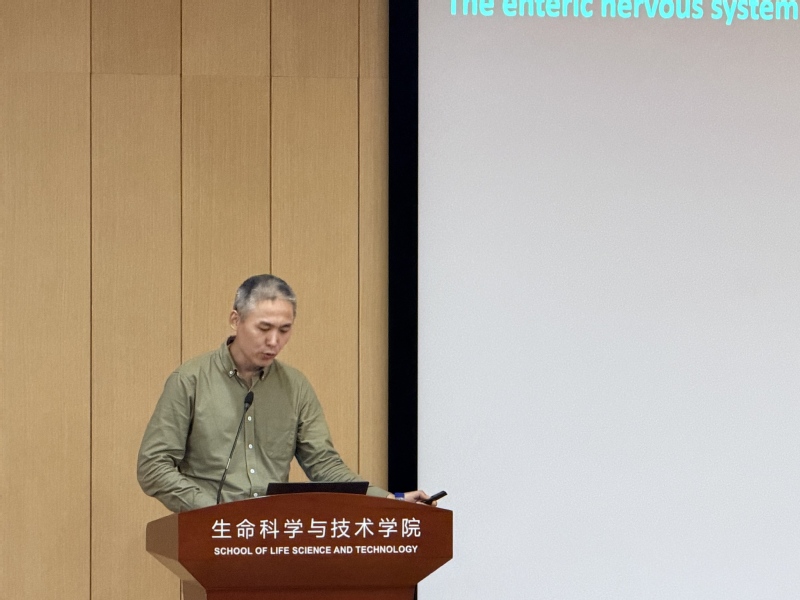
The gut possesses its own neural network of neurons and glial cells—the ENS, often called the body's second brain. Dr. Ni first outlined how the brain regulates visceral physiology via the autonomic nervous system and how peripheral organs relay internal states to the CNS through interoceptive pathways, with the vagus nerve and dorsal root ganglion (DRG)–spinal route serving as key conduits. Whether enteric neurons themselves directly contribute to such sensory signals, and how disease states alter this process, had remained unclear.
He then presented his team's study published in Neuron, An enteric-DRG pathway for interoception and visceral pain in mice. Neuroanatomical analysis revealed extensive connections between DRG sensory fibers and colonic enteric neurons. Optogenetic activation of colonic cholinergic neurons elicited clear nociceptive reflex behaviors such as hunching, an effect markedly reduced by blocking spinal sensory transmission—demonstrating that the ENS not only regulates gastrointestinal function locally but also participates in visceral sensory signaling via an enteric neuron–DRG–spinal pathway.
The team further examined the effects of intestinal inflammation. In a DSS-induced mouse colitis model, activating enteric cholinergic neurons under normal conditions produced reflex responses without obvious aversion; in colitis, the same stimulation triggered pronounced aversive behavior, which partly persisted during recovery. These findings show that inflammation reshapes the functional coupling between the ENS and peripheral sensory nerves, converting a normally neutral visceral signal into an aversive experience—revealing a key mechanism of inflammation-induced visceral pain sensitization.
The talk challenged the traditional view of the ENS as merely a local regulator of gut function and offered new directions for understanding visceral pain and sensory abnormalities in inflammatory bowel disease.
About the speaker: Ni Jinfei is a principal investigator at the CAS Center for Interdisciplinary Research in Biology and Chemistry, working on enteric neurobiology and the gut–brain axis, with a focus on enteric–CNS communication and the roles of peripheral neural circuits in visceral sensation, gastrointestinal function, and pathological pain. His team combines neural circuit tracing, optogenetics, and behavioral approaches, and has published in Neuron.