


On October 14, 2026, at the invitation of Professors Shen Wei and Tong Xiajing of SLST, Dr. Fan Zhengxiao from Shanghai Jiao Tong University School of Medicine delivered a lecture titled Neural Mechanisms of Social Competition and Its Emotional Effects. The talk focused on behavioral decision-making in social competition and its neural regulation, examining links among social rank, competitive experience, and emotional state.
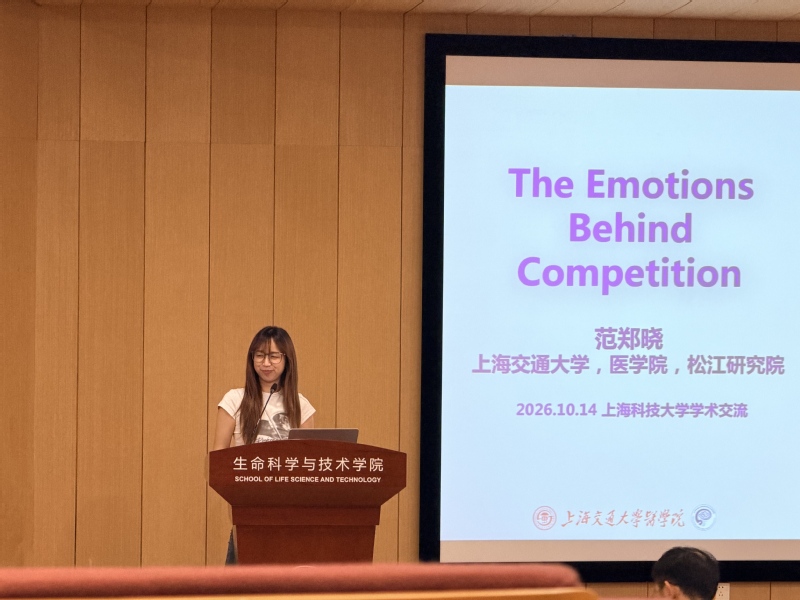
Social competition is widespread among animals and humans, shaping resource access as well as emotional states and behavioral choices. Why does a single victory make an individual more eager for the next contest? Why do individuals of different social ranks differ in competitive motivation? Addressing these questions, Dr. Fan presented his team's recent Neuron study on the circuit mechanisms underlying participation decisions in social competition.
The team developed a Win Maze behavioral paradigm that allows mice to choose whether to compete again after an encounter, shifting the focus from the competition and its outcome to the willingness to compete itself. Dominant males were more likely to re-engage after winning, while individuals of different ranks and sexes displayed distinct choice patterns, indicating that the impact of competitive experience on subsequent decisions depends strongly on social rank.
Using in vivo neural recordings, fiber photometry, and circuit manipulation, the researchers found that population activity in the dorsomedial prefrontal cortex (dmPFC) represents the competition process and correlates closely with subsequent choices, and that winning alters dopamine signaling in this region. Specific manipulation of the ventral tegmental area–dmPFC (VTA–dmPFC) dopaminergic pathway and local D1 receptor-expressing neurons bidirectionally regulated mice's willingness to compete again. These findings reveal how the brain converts past competitive outcomes into future decisions, offering a neural account of how social experience shapes motivation and emotion.
The talk illustrated a research strategy that moves from complex social behavior to the identification of key neurons and signaling pathways, deepening understanding of the neural basis of social competition and decision-making and offering insight into links between social rank and emotional disorders.
About the speaker: Fan Zhengxiao is a principal investigator at the Songjiang Institute, Songjiang Hospital, Shanghai Jiao Tong University School of Medicine. His research focuses on the neural mechanisms underlying the interaction between social behavior and emotion, particularly the roles of specific circuits, cell populations, and molecular signals in social decision-making and emotional regulation. His recent work has appeared in Cell, Neuron, and Science.